A borrowed post:
My friend Jenn Reese has some interesting advice for writers; write the scenes you want to write, or candybar scenes.
Wednesday, December 14, 2016

Friday, November 25, 2016
Wednesday, March 23, 2016
Working Title
The book I am working on right now is divided into three parts, each with focus and point of view for a single character. The first portion is Diego, the second is Elena, and the third is Frestón. I had not settled on a title for the full work until recently. The working title I have come up with is "A Palimpsest of Time."
You might well ask, what is a palimpsest? It is usually a manuscript that has been altered, with the original text erased to be re-used, but some remnant of the original remains. It is also sometimes used for places or things which have been changed but some measure of their original character is left or visible if you know to look for it. Buildings are particularly notable for these kinds of changes, in addition to manuscripts. For example, the Grand Mosque of Cordoba, the Mezquita, was enlarged several times, and then a Christian church was plunked down in the middle of it. I happened to be visiting at one point during some renovation work that revealed one of the original doorways which had been covered over when the mosque was expanded.

Friday, January 8, 2016

The Alcazar of Segovia is a remarkable place. The January sun gives it a brilliant appearance without the draining heat of summer.


The castle has two tower blocks, one at each end of the castle. In the keep, or the Tower of Juan II, there is a chamber with a high vaulted ceiling. I used this as my inspiration for the council chamber of the Count of Lastora, though I envision the Count's chamber as wide enough to comfortably hold a table and have people sit on either side of it. There is a fireplace in the center of one of the long walls of the chamber with stone benches on either side.


Friday, October 23, 2015
The mountains that cross central Spain are beautiful. I saw them mainly from the window of the train. These and the mountains between Salamanca and Segovia were my inspiration for some of the scenes of the countryside in my story, though fictionalized.


I find the exposed stone and the alternations between the barren and forested areas remarkable.
We had a different view when we went to Segovia, with higher mountains and snow in one direction, and a vast plain on the other. Segovia is located where two rivers come out of the highlands to make a naturally defensible spot.

The following photos link into a panorama of the plain.


Here they are stitched together.


I find the exposed stone and the alternations between the barren and forested areas remarkable.
We had a different view when we went to Segovia, with higher mountains and snow in one direction, and a vast plain on the other. Segovia is located where two rivers come out of the highlands to make a naturally defensible spot.

The following photos link into a panorama of the plain.


Here they are stitched together.

Wednesday, October 14, 2015
The House of Spikes
One of the remarkable houses of Segovia is called the Casa de los Picos, or House of Spikes. The front of the house is covered with remarkable granite points. It seems the house was older, with a standard facade and courtyard, and the granite facade was added later.

The house gained this appearance between about 1465 and 1500, which is the time frame I am using for the inspiration for the story of Diego.
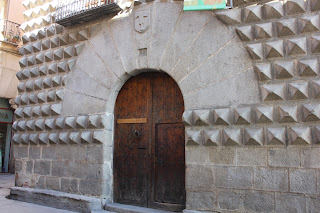
The arched doorway is typical of the region for that time period, and is the same in Salamanca, though this is particularly grand example.


There are various stories about why the house was given this appearance, from a desire to change its name to a means to express a "medieval rudeness and surliness." The house was located right by the original entry gate to the city (demolished in the 19th century). I expect the house was built as a grand and unforgettable display for everyone who entered the city, with perhaps some measure of warning about the danger or prickliness of the residents of the house.
One of the remarkable houses of Segovia is called the Casa de los Picos, or House of Spikes. The front of the house is covered with remarkable granite points. It seems the house was older, with a standard facade and courtyard, and the granite facade was added later.


The arched doorway is typical of the region for that time period, and is the same in Salamanca, though this is particularly grand example.

The windows have a tiny balcony in front, allowing a bit of access to the outside when the shutters are open, but not really enough to fully stand on.

Both the main door and the windows have a symbol over them, representing the family that added this remarkable facade, the la Hoz family. The literal translation is sickle or reaping hook; to me, this looks like a billhook, which is a pruning device for fruit trees.

Wednesday, September 23, 2015
City Walls
Salamanca has some remnants of its medieval walls, evidence for the endemic violence of the medieval period. The large scale violence of the Christian conquest of the high middle ages, or the Reconquista, gave way to factional violence between the various political entities of Iberian Peninsula. The walls are only extant in a few places. There are probably a variety of reasons for this. Part may have been tied to the destruction of the Alcazar (city fortress) when the city chose the wrong side in a factional battle in the sixteenth century. Part is due to the inconvenience of a big stone wall when there is no need for it anymore. Part is the re-use of those stones in new construction. But like many medieval cities, from York to Granada, you can find and walk along some of the old walls from the middle ages. Some of the walls of Salamanca are built directly on bedrock, where the city sat on the stone cliffs above the Rio Tormes.


The walls of Segovia are in better repair than Salamanca, in part because the medieval aspect of the city is a reason for tourism. Between the Alcazar and the cathedral, plus the association with the coronation of Queen Isabella, Segovia draws a medieval crowd. It also has the amazing Roman aqueduct, so masonry is an important part of Segovia's material heritage. The walls, which are remarkable intact, or at least repaired and renovated, can be found surrounding most of the old city.


Subscribe to:
Posts (Atom)