Wednesday, September 23, 2015

City Walls

Salamanca has some remnants of its medieval walls, evidence for the endemic violence of the medieval period. The large scale violence of the Christian conquest of the high middle ages, or the Reconquista, gave way to factional violence between the various political entities of Iberian Peninsula. The walls are only extant in a few places. There are probably a variety of reasons for this. Part may have been tied to the destruction of the Alcazar (city fortress) when the city chose the wrong side in a factional battle in the sixteenth century. Part is due to the inconvenience of a big stone wall when there is no need for it anymore. Part is the re-use of those stones in new construction. But like many medieval cities, from York to Granada, you can find and walk along some of the old walls from the middle ages. Some of the walls of Salamanca are built directly on bedrock, where the city sat on the stone cliffs above the Rio Tormes.


The walls of Segovia are in better repair than Salamanca, in part because the medieval aspect of the city is a reason for tourism. Between the Alcazar and the cathedral, plus the association with the coronation of Queen Isabella, Segovia draws a medieval crowd. It also has the amazing Roman aqueduct, so masonry is an important part of Segovia's material heritage. The walls, which are remarkable intact, or at least repaired and renovated, can be found surrounding most of the old city.


Thursday, September 10, 2015

The streets of the Juderia in Segovia seems narrower, and at least some of the houses seem taller and narrower than elsewhere in the old city. I used this distinction in my story when Diego goes and visits the armor maker, which also served to give me some ideas about the characters who lived in that area.


Tuesday, September 1, 2015

I loved the towers of Salamanca. Here is a picture of the tower at the Convent of St Ursula, taken in the evening.


Friday, August 21, 2015

Anton van den Wyngaerde was a Flemish artist of the 16th century. I first encountered his work with his Panorama of London made in 1543. He was employed for quite some time in Spain, so there are many of his panoramas of Spanish cities.

This is the 1562 panorama of Segovia. This view is looking north from the old cemetery on the opposite hill, which is why there are graves being dug in the foreground.

This view is from a slightly different spot (I think Wyngaerde was farther west), but pretty close. The tower is the Church of St Michael (Iglesia San Miguel), just east of the Cathedral. The roof has changed but the tower itself is recognizable. The hillside is now wooded, making a panorama difficult at best. 


Wednesday, August 19, 2015

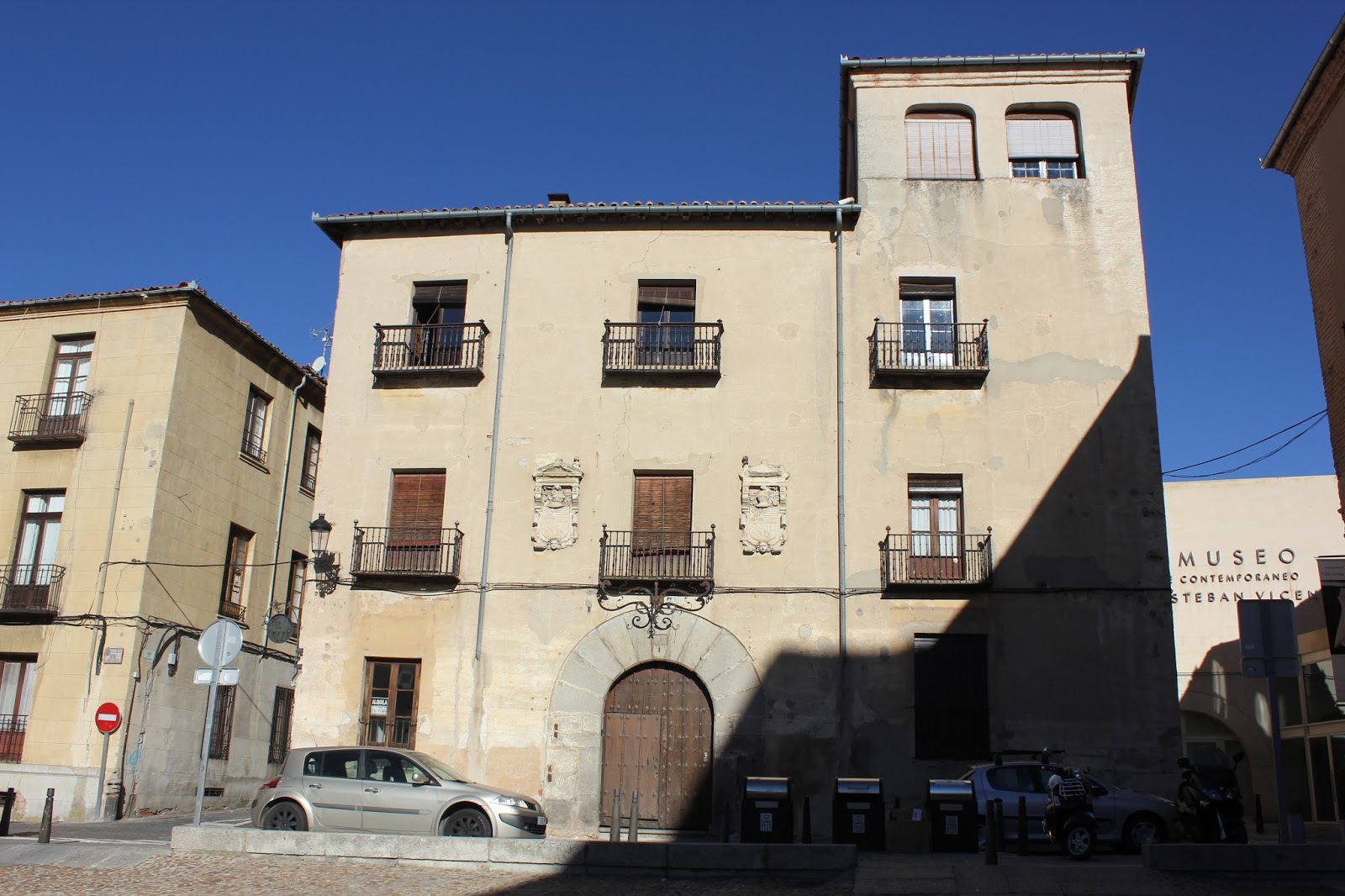
Residential towers are common among the elite residences of Salamanca and Segovia. I have used this as a model for a variety of places in the story.

This is the Torreon de Lozoya, on the Plaza of San Martin in Segovia. It was built in the 14th-16th century. Several other palaces are also located on the plaza. Here is another with a much smaller tower.


This is the Tower of Hercules, named for the mythical founder of Segovia. It was first built in the 13th century. It was the residence of the Arias de la Hoz family until 1513 when it became a Dominican convent.

Here is a closer view of the upper portion of the Tower of Hercules.

Tuesday, August 18, 2015

 Chapter 2 begins with Diego working in his garden. Most medieval and many modern cities have gardens around the margins, where the city-dwellers can grow their vegetables because the dense urban fabric makes it impossible to do so by their home.
These are the gardens outside Segovia, covered with frost in the early hours of a January morning. A fragment of wall is visible in the foreground.

The walls of Segovia on the path to the gardens.

Monday, August 17, 2015

 I have long loved the artistry that is such a big part of Spanish architecture. The melding of different traditions brings a real vitality to the spaces within the buildings. Sometimes the exteriors are grand as well, while sometimes it is mainly on the interior.
This is the chapel in the Alcazar of Segovia. Note on the left the lattice-work screen. This was originally a privacy screen, mainly so the queen could observe services without being looked at by others in the chapel. I adapted this idea for one part of the story in Torremonte.

The other side of the screen, with a seven-year old for scale.